Showing posts with label Marco Rubio. Show all posts

Monday, December 5, 2016

2016 Was The Perfect Storm For Trump


It was often wondered during the election, especially by many in #NeverTrump, by how much Ted Cruz or Marco Rubio would be leading in the polls at any given moment. This mainly stemmed from the fact that many of us were convinced that Trump would lose to Clinton in the end, probably in a landslide, and was a natural daydream to have about “what might have been”.

But Trump won after all. And the natural next question becomes, If he won, could any of those sixteen other Republicans also beat Clinton? Or was Trump unique?

I think the answer is complicated. On the one hand, the evidence—Trump’s unique appeal to working-class white voters, his rhetoric and policy positions on trade and immigration, etc.—and my own gut feeling tell me that more than likely, only Trump could have won, with the map as it ultimately appeared. Only Trump could have picked up enough working-class voters to win Michigan, Wisconsin, and Pennsylvania, the three states that put him over the top, while also taking the more traditional battlegrounds of Ohio and Florida and holding the Republican South.

But this observation also comes with the reminder that there was more than one path to victory, for Trump or any Republican candidate. Obviously these scenarios will remain forever unproven, but I believe that Rubio could have held the traditional Republican states (those that voted for Mitt Romney in 2012), carried Florida, North Carolina, Ohio, and perhaps Virginia, and also won Nevada and Colorado, while being competitive in Pennsylvania and New Mexico. Cruz would have had a narrower path, but against Clinton he too could have conceivably carried Florida, North Carolina, and Ohio, and made a play for either Wisconsin or Pennsylvania. That map, too, while offering a narrower path to the White House than Trump’s ultimately did, would still have counted as a win.

Or take Scott Walker as yet another example. Had he made it through the primaries and become the nominee, he too would have likely carried the Romney states, plus Florida, North Carolina, and Ohio, would likely have carried Wisconsin, and could have made a decent attempt at winning Nevada, Colorado, and Pennsylvania.

As I said, it’s safe to make these sorts of predictions after the fact, because we will likely never see a Cruz vs. Clinton or Walker vs. Clinton matchup in order to prove or disprove them (and if we do, and Hillary runs again, heaven help us). But my point is that all of the maps I just described would be well within the realm of possibility, which is as close to provability as we are likely to get. Hillary Clinton was fundamentally a weak candidate. Many of the Republicans who stood on that first debate stage last August could well have beaten her—just not in the same manner as Trump ultimately did.

It was a combination of many factors that led to Trump’s ultimate success. If he had run against a stronger Democratic nominee, one who could have appealed to the same base of working-class whites, Trump would have lost. If that base was not coming off of eight years of disappointment and resentment following Barack Obama’s two victories—who was initially supported by many Trump voters—he would have lost. If he had run against a smaller field of candidates in the primary, instead of the sixteen rivals who served to divide the vote enough so that, at least at the beginning, Trump could consistently win states with just 25 or 30% of the vote, he would have lost. In short, if he had run in any year other than 2016, Trump would not have even gotten close to the nomination.

This assertion does actually have some evidence to back it up. In 2012, when he was considering running for President, Trump’s name was included in some early primary polls. At first he did well, but his numbers soon tanked and he ultimately decided not to run. This year, everything had to align perfectly for him to win it all, and everything did.

We’ll see in 2020 whether those factors, combined with a new incumbency factor, line up once again for another Trump victory.


Thursday, November 10, 2016

Finding Bright Spots for Conservatives in the Results


I’ll be honest—when I planned this post, before the election, it was with the assumption that Hillary Clinton would be the next president. I expected it to be much like the exercise I did after the 2012 election, combing through down-ballot races and finding the odd conservative who survived the Democratic tidal wave to fight another day.

Today’s reality, of course, is much different. Donald Trump will be the 45th President. Throughout the election, I stated many times that I didn’t believe that Trump was truly a conservative, and was in fact just another New York liberal like Hillary Clinton. Some of the things he said seemed without any real conviction, as if he were simply sweet-talking conservatives into voting for him; other times, he didn’t even bother pretending to hold conservative convictions.

But on the other hand, Mike Pence will now be the Vice President, likely to take an active role in the administration, and his conservative credentials are largely unquestioned. And some of the speculation about Trump’s future Cabinet, if true, is equally encouraging. Rick Perry? Sam Brownback? An honest effort to eliminate the Department of Education? Far better than many dared hope. And if Trump actually sticks by his list of potential Supreme Court justices, even better.

But the bottom line is that we simply won’t know for certain whether Trump’s election is good or bad for America until January 20th, and probably for some time after that. Word is that an Obamacare repeal bill is being readied for the next Congress as I write this, one that could finally become law; as with everything else about the incoming administration, the attitude for now should be cautious optimism. Sounds good, but we’ll believe it when we see it.

Even aside from the presidential race, however, there are plenty of successes for conservatives from Tuesday night. Marco Rubio, Mike Lee, Pat Toomey, and Ron Johnson, all fairly reliable conservatives to one degree or another, will return to the Senate, and by being in the majority their clout will only be increased. In the House, only one member of the Freedom Caucus, Scott Garrett, lost reelection. Another vulnerable member, Rod Blum of Iowa, won reelection, and several other conservative candidates won House seats for the first time. They will all join another Republican House majority in the 115th Congress, as in the Senate increasing the possibilities of what they can accomplish.

In the gubernatorial races, the most conservative governor up for reelection, Pat McCrory of North Carolina, is still stuck in limbo as the margin between he and his Democratic opponent is only a few thousand votes, and a recount seems likely. Meanwhile, Republicans will succeed Democratic officeholders in Missouri, New Hampshire, and Vermont—not necessarily stalwart conservatives, but without a doubt more conservative than both their opponents and the governors they will replace. Republicans will also take control of state legislative chambers in Iowa, Kentucky, and Minnesota, further expanding an already dominant GOP majority in state governments.

So overall, Tuesday was a surprisingly good night. Whether the good news fully extends to the presidential level remains to be seen.


Wednesday, November 9, 2016

Yesterday Was The Stunning Series Finale


Note: I had intended to publish this yesterday but was unable to do so. I apologize. Regardless, I hope you find it to be a unique and entertaining take on the 2016 election.


Tonight, tens of millions of Americans will tune in to the stunning series finale of 2016, one of the most groundbreaking dramas currently on television. Anticipation has been ramping up for weeks, as the writers delivered one twist after another, leaving audiences with mouths agape, wondering what could possibly be next.

It started straightforward enough, back in Season One, with a cast of confident Republicans vying to take on the anointed Democratic nominee. But one character, Donald Trump, who started out as a seemingly minor character whose sole purpose seemed to be comic relief and an added source of tension, quickly grew to dominate the show. Whether his increasing role was the result of widespread popularity among some fans, or the writers’ intention from the beginning, has remained a secret, but he quickly shook up a sharply divided primary election, surging into the lead.

One by one, he cut down his Republican challengers. Many of the actors in those roles gave critically acclaimed performances, although those portraying the characters of Jeb Bush and John Kasich have been criticized as being “wooden” and “low-energy”. But overall, Season One—the pre-primary season—offered twists and turns that left the viewer eagerly anticipating what was to come.

And the second season did not disappoint. It kicked off with high drama on caucus night in Iowa, where Ted Cruz turned against Trump, his erstwhile ally, and won the first state in the grueling slog to 1,237 delegates. His victory was quickly beset by accusations that he had stolen votes from rival Ben Carson, by publicizing a CNN report that Carson was planning to exit the race. Trump, meanwhile, took the lead in the delegate count with a quick succession of victories in New Hampshire, South Carolina, and Nevada.

Trump and Cruz returned as season regulars, joined by John Kasich, Ben Carson, and Carly Fiorina in a recurring role. Marco Rubio also initially started the season as a regular, but his character felt increasingly robotic and underappreciated, and he was finally written off the show following a dismal primary showing in his home state of Florida.

Hillary Clinton also returned as a series regular on the Democratic side, joined on the second season by Bernie Sanders—who defied expectations by winning several primaries and offering Clinton a strong challenge from the left. Despite this, he could not ultimately overcome the Clinton machine, and by the end of the season had dropped out of the race and endorsed his former opponent.

By the final episodes of the second season, only Trump, Cruz, and Kasich remained in the Republican race—with many TV critics and fans alike wondering why Kasich had not been removed from the show long ago. Plot devices to make the character more compelling and relevant, including a brief strategic alliance with the Cruz campaign, felt contrived and overdone, and were quietly abandoned.

Still, apart from Kasich, the final episodes of the second season were strong, guaranteeing renewal. Cruz declared a major victory in Wisconsin, but was ultimately overcome in the Indiana primary and conceded defeat—though not before offering a defiant, impromptu speech declaring what he really thought of Donald Trump. The season ended with Trump the presumptive Republican nominee, ready to face Hillary Clinton in the fall.

The third season premiere was perhaps the most dramatic to date, with a showdown and near riot on the floor of the Republican National Convention over a proposed rules package. Forces opposed to Donald Trump joined with party loyalists and conservative stalwarts to attempt to force a roll call vote, a dramatic yet ultimately futile struggle that has quickly become one of the defining episodes of the series. And in the very next episode, Ted Cruz returned in a special guest role to offer a dramatic speech in primetime, pointedly refusing to endorse his former primary rival in the face of hundreds of furious delegates.

The third season has had plenty of twists and turns of its own, some better than others—from the three vicious presidential debates, to the bombshell release of tapes in which Trump was recorded bragging about sexual assault—and the flood of Republicans denouncing him, and the women who claimed that he had assaulted them, as a result. Tensions have only increased even further in the last couple episodes, as it was revealed that the FBI was reopening the investigation into Clinton’s mishandling of classified information while Secretary of State, an investigation believed to have been permanently closed at the end of Season Two.

And tonight, all will be revealed. According to the show, the race has tightened once again to within the margin of error in many polls, although Trump is still seen as the billionaire underdog. (It is a tribute to the writers of 2016 that the phrase “billionaire underdog” makes any sense at all in this context.)

Additionally, the fate of Congress and the Supreme Court hangs in the balance. Meanwhile, #NeverTrump Republicans continue to flock to the independent candidacy of Evan McMullin, who hopes to throw the election to the House and become, in the process, the first independent candidate for President to win statewide in decades.

Will he succeed? Will Hillary Clinton be elected the first woman president? Or will the late reversal by the FBI usher in a President Trump? Tune in tonight at 7/6c for the special, extended series finale of 2016.

Monday, November 7, 2016

The End Is Almost Here


It’s been a long five years sixteen months, but we are finally at the end of Campaign 2016. By the end of this week, we will have a new president-elect, the fate of the Senate will (presumably) be known, and America can finally begin the process of healing and rebuilding. At least until 2018, that is. And expect the jockeying for 2020 to begin in earnest by Christmas.

Up until two weeks ago, I was certain Hillary Clinton would be the 45th President. After the FBI’s announcement that they were reopening (and then re-closing) the email investigation, I am no longer convinced of that fact. I still think it more likely than not, but not a done deal as it was a few weeks ago. The good news is that, if Clinton does win, it will probably not be in an Electoral College landslide, which means that Republicans will probably retain the House, and the Senate is at worst still a tossup.

This of course has much more to do with the fact that Clinton is a superbly bad candidate, rather than that Trump is a magnificently good one. Were Ted Cruz, Scott Walker, or Marco Rubio the nominee, we could well be looking at a Republican Electoral College landslide, even factoring in the endless Clinton mantras about electing the first woman president, and the House and Senate would be practically in the bag. We would be looking at a historic conservative victory, were it not for a plurality of the Republican primary electorate—many of whom were actually Democrats.

But regardless, the die has been cast, and we will all (probably) know the outcome by the end of this week.

Next week, the hard part begins—uniting a nation, rebuilding a party, and reinvigorating the conservative movement.


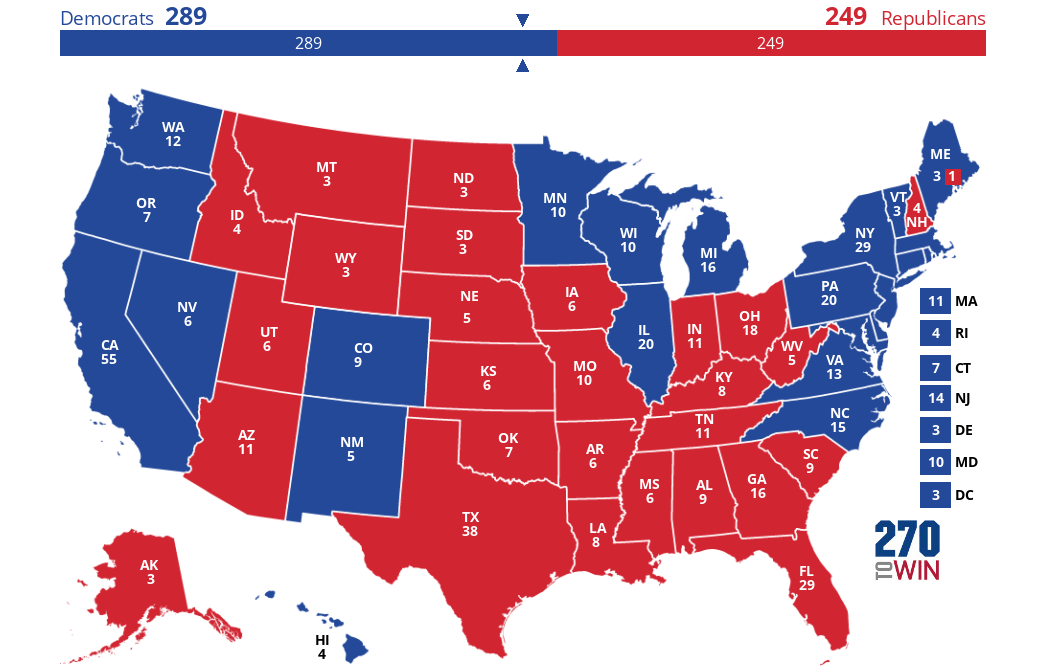
Update: Here's my Electoral College map prediction for tomorrow night:
.


Click the map to create your own at 270toWin.com

Tuesday, October 25, 2016

Checking In: The State of the House, Senate, and Gubernatorial Elections


With exactly two weeks to go, now is the ideal time to revisit my overview of the major Congressional and gubernatorial races from back in September (the original pieces can be found here, here, and here). Thirty-four Senators are up for reelection or are retiring, along with twelve governors and all 435 members of the House—so in the interest of space, I’ll only spend time on those races where something fundamental has changed since the original assessment.

The House: Not many individual races seem to have shifted significantly in the past two months, but there is a growing perception among Democrats that they are, if still unlikely to win back control of the House, at least better positioned than they were even one month ago. Three orange guesses as to why.

As in September, Democrats look likely to pick up several seats. And as in September, no particularly well-known members look likely to lose their races—although longstanding incumbents like John Mica in Florida and Freedom Caucus member Scott Garrett in New Jersey are struggling more than expected. Again, three guesses why.

The Senate: Back in September, I listed five races that I viewed as the most competitive in the country (Nevada, Florida, Pennsylvania, Ohio, and New Hampshire); along with five that had the potential to join their ranks should circumstances change (meaning Democratic improvements in North Carolina, Arizona, and Missouri, and Republican improvements in Illinois and Wisconsin). Since then, Nevada, New Hampshire, and Pennsylvania have remained virtually unchanged, with the margins for all three in the latest RealClearPolitics polling averages less than two points. In Ohio, Rob Portman is now leading consistently by double digits, and Democrats seem to have all but given up on the race. And in Florida, national Democrats also seem to have given up on the Senate seat and begun focusing on the presidential race, as Rubio has also consistently led in the polls, albeit by a smaller margin—although the past several surveys have also shown his lead shrinking somewhat. Whether that trend continues through Election Day remains to be seen, although it would still be a massive shock if he actually lost.

Of the five sleeper races, Arizona looks to be out of reach for Democrats, as John McCain continues to put it away despite Trump falling behind Clinton in the normally red state. The last public poll had McCain leading his Democratic opponent by sixteen points. Missouri and North Carolina, on the other hand, have only gotten closer in the past two months, with surveys in both states showing races that are statistically tied. Trump runs about even with Mitt Romney’s 2012 showing in Missouri, but about four points behind Romney in North Carolina, and behind Senator Richard Burr by the same amount—implying that Burr would likely be doing at least marginally better with another candidate at the top of the ticket.

Another race has become much more competitive since early September, as former Senator Evan Bayh made a late announcement over the summer that he would try to reclaim his old Indiana Senate seat for the Democrats. With Republicans defending an open seat with a candidate who has never before held statewide office, against a former Senator who has strong name recognition in the state, Indiana could be another state that determines the balance of power in the Senate. Bayh has held a fairly consistent polling lead, although it has fluctuated between one and seven points in just the past month, and persistent charges that he hasn’t truly lived in the state for years make come back to cost him in the end.

So, overall, control of the Senate could tip either way, although at this point a slim Democratic majority looks most likely.

Governors: As far as general race ratings, little has changed over the past two months. Democrats are still certain to hold Delaware; Republicans, North Dakota and Utah. Missouri, Indiana, New Hampshire, North Carolina, Oregon, and Washington have all been polled fairly recently, and all continue to display similar results: a small Democratic lead in Missouri; larger, but still surmountable, Democratic leads in Oregon and Washington; and extremely tight races in North Carolina and New Hampshire. There have now been several polls conducted of Indiana since Mike Pence was chosen as Trump’s running mate and was replaced as the Republican nominee for governor, enough to show that John Gregg, the Democratic nominee, has benefitted the most from the change. He has led by twelve and five points, respectively, in the last two polls, although the race could still tighten.

Unfortunately, because of the focus on the presidential and Senate races, only one gubernatorial poll has been conducted in Vermont since September, and none at all in Montana or West Virginia. That single poll showed the Republican nominee ahead by one point, seeming to imply that my prediction that the race could be close is accurate. But a single poll is nearly meaningless without corroboration—and there is still no data to show whether there are similarly tight races in West Virginia and Montana. With the attention of the major pollsters fixed on the Senate and gubernatorial races, unfortunately, it looks like the first hard indications will come on Election Night itself.